
How to Choose a Booking Engine for Your Hotel Website
September 11, 2026
Choosing a booking engine is not a feature-list comparison. Five criteria decide it: parity, mobile flow, payments, two-way sync and the pricing model.
In Short
A hotel booking engine is the software on your own website that carries a visitor from date selection through to payment, showing live availability and rates and closing the reservation; it does not replace a PMS or a channel manager, it connects on top of them. Most hotels choose one by comparing feature lists, but five criteria actually decide the outcome: rate parity against the OTAs, how many steps it takes to reach payment on a phone, whether the payment layer handles local cards and 3D Secure cleanly, whether the sync with your PMS and channel manager is two-way and immediate, and whether the pricing model is per-booking commission or a flat licence. At 200 direct bookings a month with a 300 dollar average value, a 3 percent booking commission costs about 21,600 dollars a year against far less for a flat licence. And if the engine does not run on your own domain or export behavioural data, you cannot tell which campaign produced the booking.
"Which booking engine works best with my website?" It is one of the questions we hear most often from hoteliers, and it has no answer — because the question is framed wrong. Most booking engines do the same basic job: pick dates, show availability, quote a rate, take payment. What separates them is not the feature list. It is what happens in the forty seconds between the rate screen and the payment confirmation.
This post gives you a framework for the questions worth asking in a demo: what the engine actually does and does not do, the five criteria that decide the choice, and the measurement step most hotels skip once the engine is live.
What a Booking Engine Actually Does
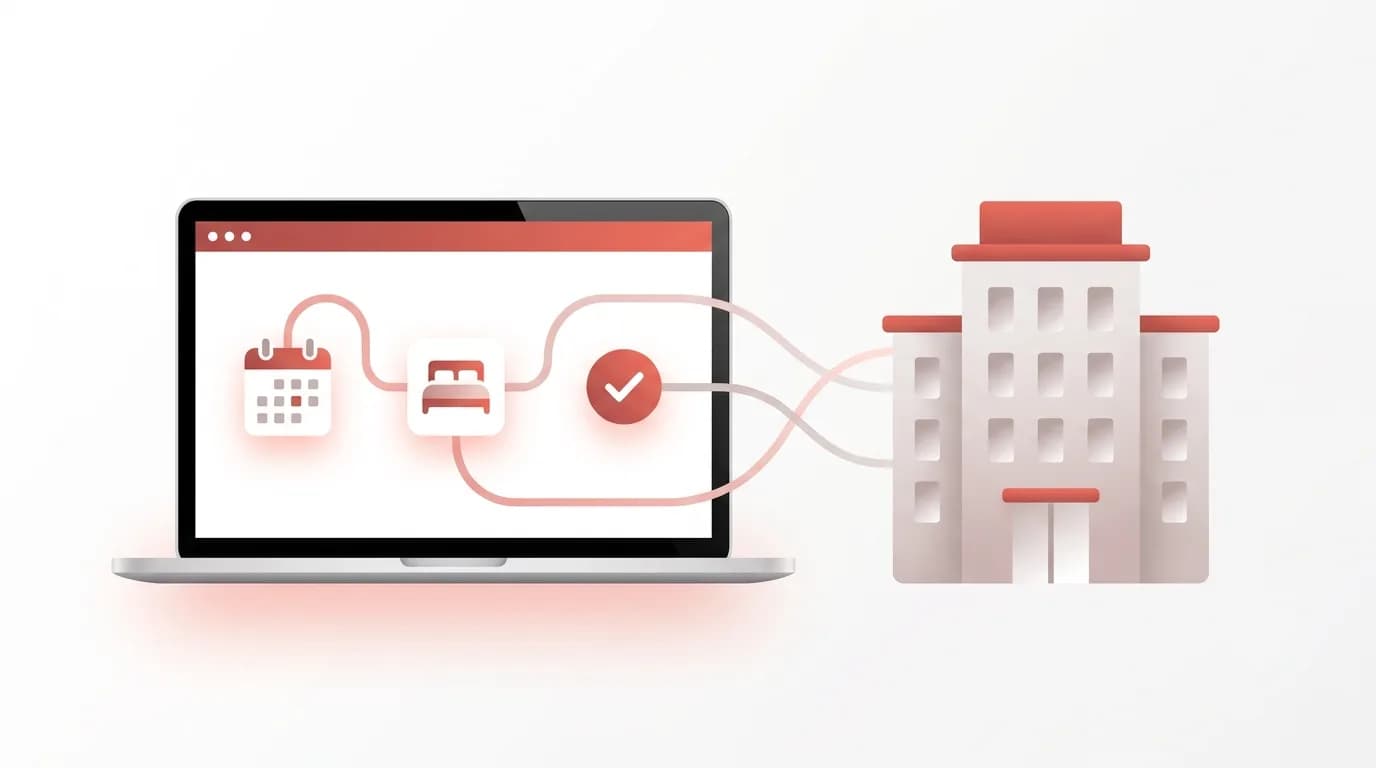
A booking engine is the software running on your own website that moves a visitor from date selection to payment confirmation. It shows live availability and rates, lets the guest pick a room and board type, offers extras, collects guest details and takes the money.
What it does not do matters more, because this is where hotel technology gets muddled most often:
- It is not a PMS. Room plans, check-in and check-out, folios and accounting belong to the PMS. The engine only owns the moment of sale.
- It is not a channel manager. Distributing inventory and rates to the OTAs is the channel manager's job. The engine is the sales interface of exactly one channel: your own site.
- It is not a marketing system. The engine converts the traffic it receives. Bringing that traffic in, targeting the right user and knowing which campaign turned into a booking is a separate layer entirely.
We covered how those three connect — and what leaks when they do not — in you use a hotel PMS and channel manager, why aren't you earning more. The engine is a single link in that chain, but because it is the last screen a guest touches, it is the most visible one.
Criterion 1: Rate Parity — The One Problem No Engine Can Fix
When a guest searches your hotel name, your site and the OTA listings appear side by side. Same room, same dates, two different prices — the decision takes a second, and it does not go your way. However good the engine's interface is, it will not compensate for a price disadvantage.
So the first criterion is commercial, not technical: does the engine let you build a better offer on your own site than the OTA shows? In the demo, ask it concretely: how many clicks does it take to define a direct-only benefit — a member rate, late check-out, a free upgrade, breakfast included — and does the guest see it on the rate screen?
Note the distinction: the answer to parity is not always "be cheaper". Most OTA contracts restrict advertising the same room at a lower price, but they do not restrict giving more for the same price. An engine that cannot package flexibly condemns your direct channel to a price war it will not win.
How the price itself is displayed is a conversion factor in its own right — when taxes and fees appear, at which step the total becomes final. We went through that in how hotel website price transparency increases bookings.
Criterion 2: The Mobile Flow — Count the Steps
Most hotel website traffic is mobile, and most booking engines were designed on desktop and squeezed onto a phone afterwards. During the demo, ignore the presentation screen and look at your own phone. Count one thing: how many screens separate the homepage from the payment form?
In practice a good mobile flow does not exceed four steps: dates and occupancy, room and board, guest details, payment. Every extra step hands a guest who has already decided a fresh chance to change their mind.
Three more things to check on mobile:
- Calendar usability. Does the date picker show sold-out dates, or does the guest discover them by trial and error?
- Back-button behaviour. When the guest steps back from room selection, are the dates preserved or does the form reset? A form that resets is an abandoned booking.
- Load time. If the engine opens in a separate window behind a heavy script, the guest is waiting before they even see a price. We wrote about how early that decision is made in why the booking decision takes only a few seconds.
Criterion 3: Payments — The Last Metre Where Bookings Disappear
A guest who reached the payment screen has already decided. When they turn back, the reason is almost never price — it is technical friction. Questions worth asking:
- Local payment support. Does the engine work cleanly with your acquiring bank's gateway and the 3D Secure flow your market uses? Some engines only support a single international processor, which pushes up failed-transaction rates on local cards.
- Instalments and deposits. On high-value leisure bookings, instalment payments are a direct conversion lever. Can the engine set instalment rules by room type or date?
- Pay-at-hotel. For some guest segments, prepayment by card is itself the obstacle. Can you take a guaranteed booking without charging it?
- What happens after a declined payment. Does the guest start over, or can they retry against the same reservation? That single detail explains a surprising share of lost bookings.
- Currency. Can an international guest see the rate in their own currency, and at which rate is the charge settled?
Criterion 4: PMS and Channel Manager Connection
If bookings do not land in the PMS, the front desk keys them in by hand; if inventory does not reach the channel manager instantly, the same room gets sold twice. So the integration question is never "is it supported?" but "how is it supported?"
- Is it two-way? Can the engine pull availability and rates from the PMS and write reservations back, or does it only run in one direction?
- What is the sync delay? Real time, or a batch transfer every few minutes? In peak season that difference is spelled overbooking.
- Is the integration ready or a project? If a connector already exists for your PMS and channel manager, setup takes days; "we can develop it" means months and extra cost. Ask the vendor for a reference hotel running the same PMS as you.
- What happens when the connection drops? Does a sync failure raise an alert, or does it just stop quietly? A silent integration costs you sales until someone notices.
Criterion 5: The Pricing Model — Commission or Flat Fee?
Booking engines are usually priced one of two ways: a commission per booking (typically in the 2-5 percent band) or a flat monthly or annual licence. Which is cheaper depends entirely on your volume, and the maths takes less than a minute.
Take a 100-room city hotel: 200 direct bookings a month, average booking value 300 dollars.
| Model | Monthly cost | Annual cost |
|---|---|---|
| 3% booking commission | 200 × 300 × 0.03 = 1,800 dollars | 21,600 dollars |
| Flat licence (example: 500 dollars/month) | 500 dollars | 6,000 dollars |
At that volume the gap is roughly 15,600 dollars a year. Now invert it: a 30-room boutique doing 20 bookings a month pays 2,160 dollars on commission and still 6,000 on the flat licence. The right answer is property-specific, and the break-even is simple: flat fee ÷ (average booking value × commission rate). In the example above that is roughly 56 bookings a month; above that, the flat model wins.
Two warnings: on a commission model, always ask whether cancelled bookings are still charged; on a flat model, get it in writing whether setup, integration and support are included in the licence. For the same reasoning applied to OTA commissions, see the real cost of OTA commission and the hotel revenue distribution calculator.
The Criterion That Never Appears on a Feature List: Your Data
If two engines clear all five criteria, this is what decides it: does the engine give you your own data? It breaks into three questions.
Does it run on your own domain?
Does the engine live under something like booking.yourhotel.com, or does it open in a window on the vendor's domain? The second case carries a real measurement risk: the visitor who arrived from an ad and the user who completed the booking can look like two separate sessions, and the ad platform may credit the conversion to the wrong channel.
Can it export behavioural data?
Not just "how many bookings", but how many people dropped at which step. If you do not know the share of guests who pick dates, reach the room screen and leave once they see the price, you can never separate a pricing problem from a flow problem. We show how those behavioural signals are read through Convertels Pulse.
Can phone bookings be tied to the same journey?
A meaningful share of hotel bookings still closes on the phone. The guest browses the site, sees the rate, then calls. To the engine that is an "abandoned booking" — when in fact the sale happened. Without that match, you will consistently read your website and your advertising as weaker than they are. Making that connection is not the engine's job but the job of the measurement and call layer built on top of it; we describe how that layer works on the hotel reservation system page.
The Weighting Changes by Hotel Type
Not every criterion matters equally to every property. The same engine produces very different results at two hotels, because guest behaviour and sales mix differ.
- City hotel: short decision window, heavy mobile share, many single-night bookings. Step count and payment speed decide it; instalments are almost never used.
- Resort: high booking value, long decision window, families. Instalments, deposit rules, child-age policies and board-type logic come to the front; the engine must handle complex rate rules without error.
- Boutique: low volume, strong brand attachment. A flat licence is usually poor value; packaging flexibility and a real direct-channel advantage do more work.
- Chain: multi-property management, central reporting and a single membership/CRM pool are non-negotiable. An engine that is excellent for one property can become an admin burden across ten.
We covered the advertising and budget side of that segmentation in ad strategy by hotel type; engine selection follows the same lines.
The Five Criteria in One Table
A summary worth printing before the demo:
| Criterion | Ask in the demo | Red flag |
|---|---|---|
| Parity | How many steps to define a direct-only package? | Only percentage discounts are possible |
| Mobile flow | How many screens from homepage to payment? | The form resets on the back button |
| Payments | Is my acquiring bank's gateway and 3D Secure flow supported? | Locked to one international processor |
| Integration | Is there a live connector for my PMS, and who is the reference? | "We can develop it" |
| Cost | Is commission charged on cancellations and no-shows? | Setup/support fees missing from the contract |
Red Flags in a Demo
Note it down when a vendor answers with any of these:
- "The integration can be developed." — It does not exist today; ask for a timeline and a price.
- "We store the data and give you reports." — You cannot get the raw data out.
- "It works on mobile too." — Working and flowing are not the same thing; test it on your own phone.
- "Commission is on the booking value." — Get the cancellation and no-show treatment in writing.
- No exit clause in the contract: if the format and timeframe for getting your data back is not written down, switching engines later becomes a project of its own.
After the Choice: Installing an Engine Is Not the Finish Line
A booking engine is a converter, not a demand generator. Your direct share will not rise on its own after the switch; what rises is your ability to close demand that already exists. Measure three things in the first 90 days:
- Step-by-step drop-off. Where the biggest loss sits across dates → room → guest details → payment.
- Direct channel share. Direct room nights as a share of the total, compared with the three months before the switch.
- Total direct bookings including the phone. Not just the engine's own report, but the number with phone reservations folded in.
If you cannot see that third number, you cannot fairly judge the engine either. If you want to tick the criteria off one by one during your evaluation, our hotel reservation software evaluation guide walks through it as a question-by-question checklist.
See how many bookings your current engine is losing
Before you replace the engine, answer two questions: at exactly which step are guests dropping out of today's flow, and do phone bookings show up in your measurement at all? For a short assessment that produces both numbers, get in touch.
Hotel Reservation SystemSources
Sources on booking-flow speed and abandonment:
- web.dev — Optimize Largest Contentful Paint— How quickly the first meaningful content of a page appears
- Baymard Institute — Cart abandonment rate statistics— Compiled research on why people abandon online purchases
Related Posts

You Use a Hotel PMS and Channel Manager—So Why Aren’t You Earning More?
There’s a long-standing misconception in hospitality: that PMS and Channel Manager systems are enough to sell rooms and increase revenue. In reality, they are passive tools that manage operations and inventory—yet they can’t answer, “Which ad did this sale actually come from?”
Price Display on Your Hotel Website: How Transparency Increases Bookings
Guests don't leave because the price is high — they leave because they can't trust a total that changes at checkout. How transparent pricing lifts bookings.