
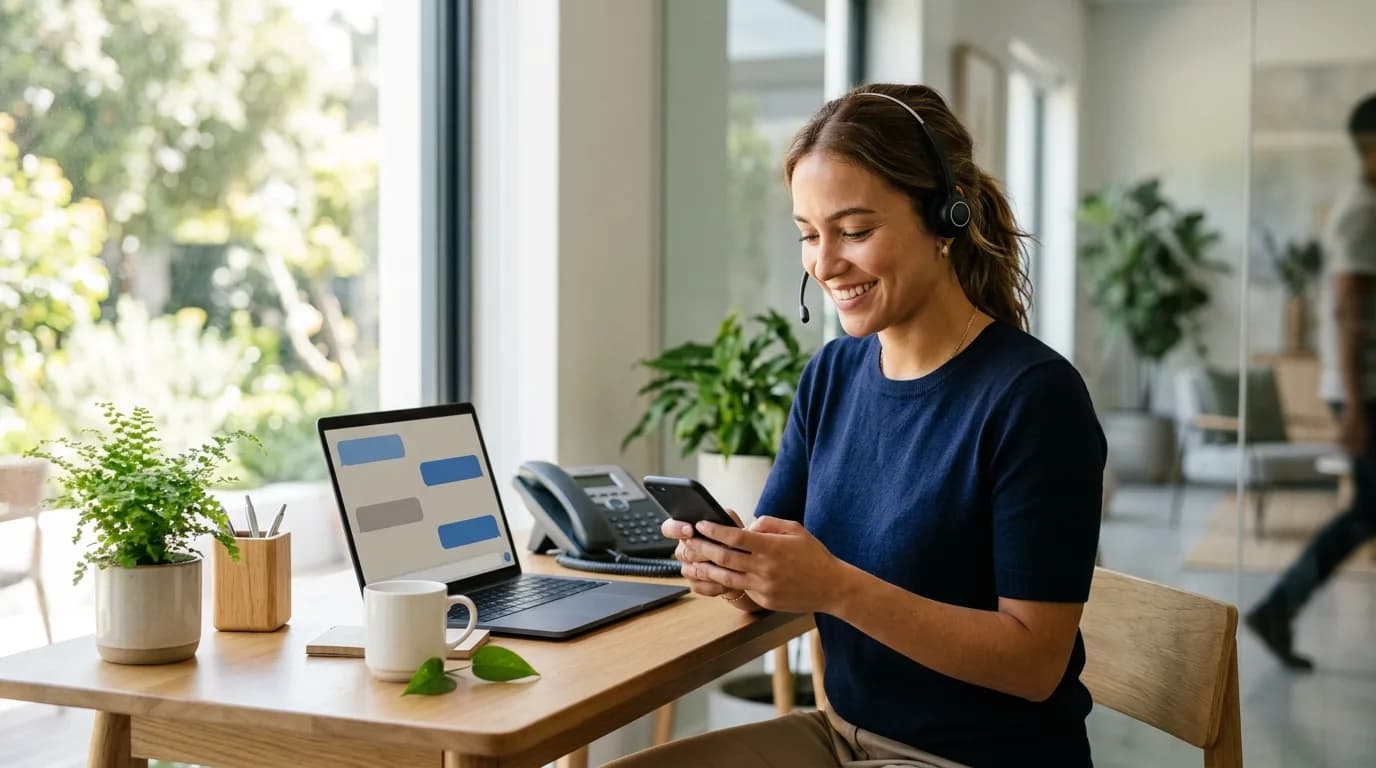
Hotel Guest Messaging: How WhatsApp, Live Chat and Phone Work Together
October 26, 2026
Guests ask before they book, via WhatsApp, live chat or a phone call. The problem is not how many channels you run but who owns each enquiry, how fast they reply, and one report.
In Short
Hotel guest messaging is how a hotel handles pre-booking questions that arrive through WhatsApp, live chat on its website and the phone. The real problem is not the number of channels but ownership of each enquiry: a price question sent on WhatsApp is often answered on a front-desk phone but never recorded, so if the guest later books through an OTA, nobody sees that the demand reached the hotel first and ended up paying commission. A healthy setup rests on three rules. First, every enquiry has a single owner, and that ownership follows the guest across channels: a conversation that starts on WhatsApp and continues by phone sits in one guest record. Second, each channel has its own response-time target, such as answering calls within a few rings, live chat within a minute and WhatsApp within minutes during office hours. Third, message and phone enquiries appear in the same report, so the hotel can see which channel actually turns into bookings and which requests go unanswered.
Guests no longer come through a single door. On the same evening, one guest types into the chat bubble on your website: "First week of August, two adults and a child, what's the price?" Another taps the WhatsApp link on your Instagram profile and asks the same thing. A third simply calls the front desk. All three are close to booking, and all three need an answer within the hour. Yet in most hotels those three enquiries end up in three different places: one in a chat dashboard, one on a mobile phone behind reception, and one nowhere at all.
This article treats hotel guest messaging not as a question of adding channels but as a question of enquiry ownership. The useful question is not "Should we open a WhatsApp line?" but "When a price question arrives on WhatsApp, who answers it, how quickly, and do we know what happened next?"
Which Channel Do Guests Use Before They Book?
Pre-booking contact comes through three main channels, and each one carries its own guest behaviour:
- Phone: the channel closest to the decision. A guest who calls usually has fixed dates, a rough idea of the price and one last thing to clarify: the child rate, the difference between room types, the cancellation terms. We explained why these calls convert so well in why phone reservations are more valuable.
- WhatsApp: in markets like Turkey, the channel guests feel most comfortable with. Guests who hesitate to call, who ask outside office hours, or who want photos or a location pin write here. The enquiry is usually one step earlier than a phone call: "What's the price?", "Do you have availability?"
- Live chat on the website: the guest is already on your site, right next to the rate screen. The question is often a moment of doubt: "Is breakfast included at this price?", "Is the pool heated?" If it isn't answered within minutes, the guest closes the tab and looks up the same hotel on an OTA.
These channels are not alternatives to one another; the same guest often uses more than one. Someone who gets no reply in the chat bubble switches to WhatsApp, and when that is slow too, they call. A hotel that manages each channel separately sees one guest as three different people, or doesn't see them at all.
Where Does the Enquiry End Up? The Real Source of Loss
A hotel's messaging channel usually starts like this: someone installs WhatsApp Business on a mobile phone at reception and puts the number on the website and Instagram. For the first few weeks it works. Then this happens:
- The day shift reads a message and replies "we'll get back to you this evening"; the evening shift never knows that promise was made.
- The phone is charging or sitting in a drawer; by the time the message is read, the guest has already booked somewhere else.
- The price question is answered, the guest says "I'll think about it", and the conversation stops there. Nobody follows up two days later, because that conversation lives in one phone's chat history, not on a list.
- The guest eventually books through an OTA. The hotel pays commission and never learns that the demand originally landed on its own WhatsApp.
Each individual loss looks small. But for a hotel receiving 40 pre-booking messages a week, if just a quarter of them go unfollowed and drift to an OTA or a competitor, around 40 warm enquiries disappear every month. With an average stay of three nights at 3,000 TL a night, that is roughly 360,000 TL of monthly demand leaving the building without even being recorded. Some of it does come back through an OTA, but then it comes back carrying a 15 to 20 per cent commission.
The problem isn't WhatsApp itself. The problem is that the enquiry belongs to a device rather than to a person. We looked at how a missed call turns into lost revenue in is a missed call really a lost opportunity? On messaging channels the same loss is quieter, because "read but not answered" never sets off an alarm.
Enquiry Ownership: Every Conversation Needs an Owner
Whatever the number of channels, the rule that works is simple: every pre-booking enquiry has a single owner, and that ownership moves with the guest when they switch channels. In practice this means three things:
- The enquiry becomes a record. Every booking question from WhatsApp, chat or phone is opened as a record with the guest's name, dates, party size and the price quoted. The record lives in a system the whole team can see, not on a single device.
- The record is assigned to a person. "Reception will handle it" is not ownership. During office hours a named person on the reservations team owns it; out of hours, the person on duty or the call centre does.
- Records merge when the channel changes. When a guest who asked for a price on WhatsApp in the morning calls in the afternoon, whoever picks up should see the morning's conversation and the price already quoted. Asking the guest the same questions twice costs both trust and time.
The systems side of this, getting the booking engine, CRM and call centre to share the same data, was the subject of why CRM, booking and call centre systems should talk to each other. The focus here is the guest's side: whichever door a guest walks through, they should find a hotel with the same memory behind it. You can see how the layer that holds that memory works on the Hotel CRM System page.
Response-Time Targets by Channel
Guests expect different things from each channel; a single "we'll get back to you as soon as possible" satisfies none of them. The table below shows reasonable starting targets for pre-booking enquiries. The figures are not a standard, just a frame to start measuring against:
| Channel | Guest expectation | Office-hours target | Out of hours |
|---|---|---|---|
| Phone | To talk right now | Answer within 3-4 rings; call back missed calls within 15 minutes | Route to a call centre, or call back first thing next morning |
| Live chat | An answer while still on the site | First reply within 1 minute | A form asking for contact details instead of chat, with a "we'll reply at 9am" note |
| A quick, written reply | First reply within 5-10 minutes | An automatic greeting plus a personal reply first thing in the morning |
Two things are worth noting. First, a "first reply" is not the same as a resolution. "Hi, I'm checking availability and will send you the price in two minutes" is a first reply, and it keeps the guest. Second, automatic greetings don't count as a first reply. Guests know that "your message has been received" doesn't mean a person has looked at it; an auto-reply only helps when it honestly says when a real answer will come.
Out-of-hours deserves separate thought. A large share of pre-booking messages arrive after dinner, when guests are discussing holiday plans with their partner or family. Answering a price question sent at 10:30pm by lunchtime the next day gives the guest plenty of time to book another hotel over breakfast. A setup that doesn't cover those hours hands the busiest slot of demand to the competition.
Phone and Messaging Are Not Competitors
Some hotels see messaging as a way to "take load off" the phone. In reality the two channels complement each other. A price question on WhatsApp is usually the start of the decision; the guest is asking several hotels at once. The phone call is the end; the guest is about to choose. So the most effective flow is often this:
- The guest asks for a price on WhatsApp and gets a clear written answer: dates, room type, board basis, total, cancellation terms.
- If the guest hesitates or keeps asking, the agent offers: "Shall I give you a quick call so we can settle it in two minutes?"
- The call is short and focused, because the agent can see the earlier messages. We covered why it should be short in why a good reservation call is short.
- If the booking isn't completed, the record stays open with a follow-up date.
This flow combines the speed of messaging with the persuasive power of a conversation. The opposite, leaving messaging to a team entirely separate from the phone, means "handing over" the guest from one channel to another at the warmest moment of their decision. You can see how reservation calls are handled by a specialised team on the Hotel Call Center page.
Seeing Message and Phone Demand in One Report
A channel you don't measure is a channel you can't manage. Most hotels at least know how many calls they miss; on the messaging side there is usually no data at all. To see message and phone demand in the same table, these metrics are enough:
- Enquiries by channel: how many booking questions came by phone this week, how many via WhatsApp, how many through chat?
- First-response time (median): the median rather than the average; one 14-hour delay distorts the average, but the median shows the real pattern.
- Unanswered or unfollowed enquiries: messages read but not answered, calls never returned.
- Enquiry-to-booking conversion, by channel: out of 100 price questions on WhatsApp, how many became bookings? Out of 100 calls?
- Source: which ad, page or profile did the enquiry come from? "WhatsApp" and "Call now" clicks on your site are the most direct signal of the contact intent your advertising creates.
Once this table exists, two things usually surface. First, messaging volume is bigger than anyone thought: management believed "we get a few questions on WhatsApp", and it turns out to be dozens of pre-booking enquiries a week. Second, messaging converts worse than the phone, but not because of guest intent; the cause is response time and missing follow-up. You can see what the measurement layer looks like on the phone side on the Advanced Call Reports for Hotels page.
Personal Data and Consent: Two Rules
Messaging channels carry the guest's name, phone number, dates and sometimes identity details. Two rules matter:
- Conversations shouldn't live on a personal phone. Guest chats kept on a staff member's own device are a risk for both business memory and personal-data control when that person leaves. Enquiry records belong in a system the hotel controls.
- A reply is not a marketing message. Answering a guest's question is service communication. Sending a campaign to the same number months later is a commercial electronic message and requires prior consent. If a guest said "I'll think about it", following up on that same enquiry within a few days is reasonable; turning it into a campaign list is a separate consent question.
A Four-Step Checklist to Get Started
- Take inventory: where do booking questions come from? The website chat bubble, the WhatsApp link, your Google Business Profile, Instagram, the phone. Whose device or dashboard does each one land on?
- Write down the ownership rule: who owns enquiries during office hours, and who out of hours? How are open enquiries handed over at shift change?
- Count by hand for a week: before buying any system, log every booking question for one week with its channel, first-response time and outcome. That table shows where to invest better than any software demo.
- Tie it to a single report: start seeing phone and message enquiries in the same weekly report, with their source. Only then does it become visible which ad generates calls and which generates WhatsApp enquiries.
In the end, guest messaging is not about opening more doors for guests; it's about making sure that behind every open door there is a hotel with the same memory, answering on time. Adding a channel is easy; making sure no enquiry is left without an owner is a matter of process.
Where do your pre-booking enquiries end up?
Convertels answers phone reservation enquiries with a specialised call centre team, records every enquiry in the CRM, and reports phone and WhatsApp clicks on your site as contact intent alongside the ad source that drove them. Let's map your channel mix together.
Get in touchSources
The framework for keeping guest conversations on record, and for consent before any later commercial message:
- KVKK — Turkish Personal Data Protection Authority— Regulator for the processing, storage and transfer of personal data
- Turkish Ministry of Trade — Message Management System (İYS)— Official registry of consent for commercial electronic messages
For a deeper look at this topic, see Hotel PBX System.
Related Posts
Why Should CRM, Booking, and Call Center Systems Communicate with Each Other?
Today, many hotels invest in digital infrastructure but use their CRM, booking software, and call center separately. Learn why system integration is crucial for direct booking performance and guest experience.
Is a Missed Call Really a Lost Opportunity?
Seeing zero missed calls on the PBX screen looks like success. But the real massive leak is hidden in those calls that were answered instantly and "successfully" — while no one ever knew what was being lost in the background.