
Cloud PBX vs. Traditional PBX: Hotel Phone Systems Compared
September 22, 2026
The difference between a cloud PBX and a traditional PBX is not technology but ownership. A hotel-specific comparison of cost, seasonal flexibility, room phones and outage risk.
In Short
The real difference between a cloud PBX and a traditional PBX is not call quality or how modern it feels, but the ownership model. A traditional PBX is hardware sitting in the hotel's own equipment room, bought once, depreciated over years and maintained on site; a cloud PBX runs in the provider's data centre, is rented per extension per month and is managed over the internet. For hotels this matters in three places. First, seasonal staffing: a resort running 25 extensions in summer and 8 in winter buys peak capacity with a traditional system, but pays only for what it uses in the cloud. Second, remote management: chains and multi-property groups get one admin panel and a central reservations number. Third, continuity: a cloud PBX depends on the internet, so a second line or mobile backup is essential. For room phones and the PMS interface, the most realistic answer for most hotels is hybrid: rooms stay on an on-site gateway, revenue lines move to the cloud.
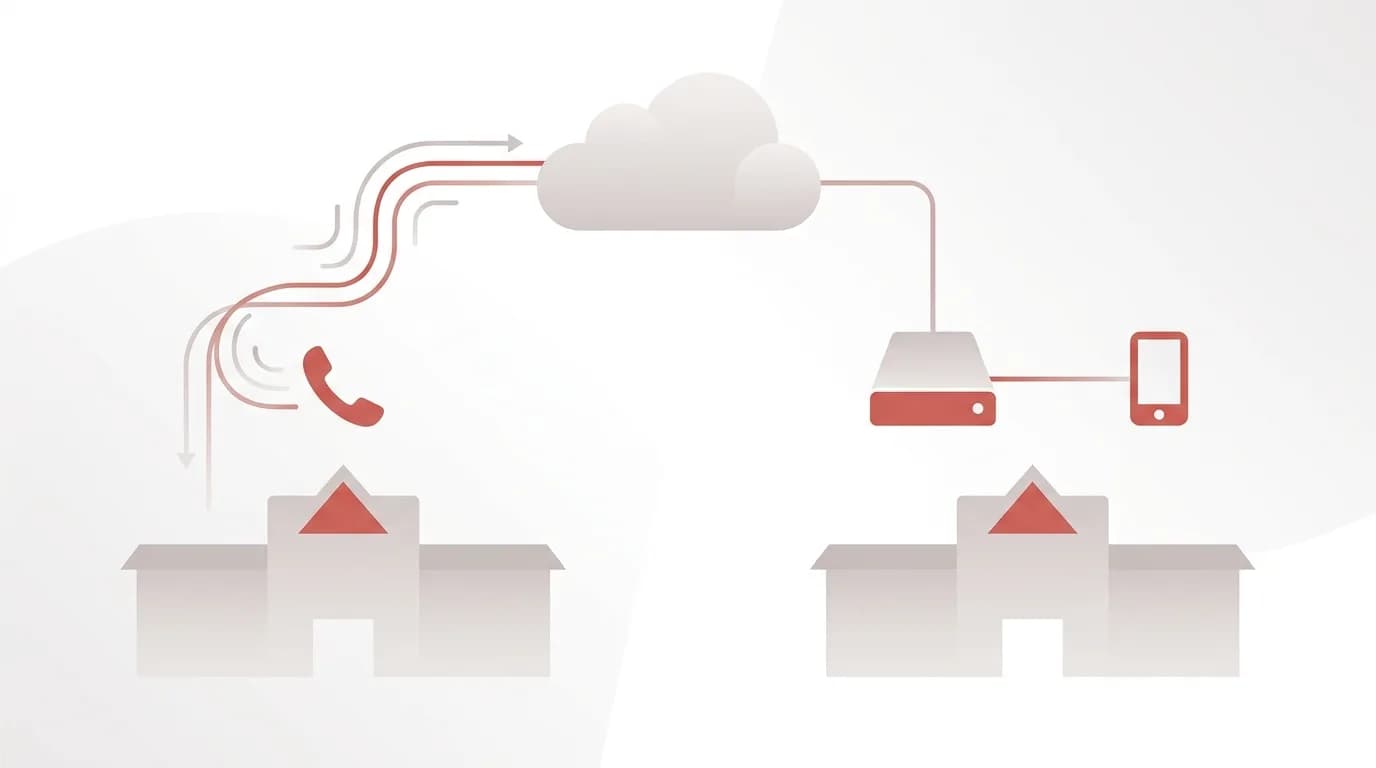
Choosing between a cloud PBX and a traditional PBX is not really a technology question — it is an ownership question. A traditional PBX (on-premise) is hardware that sits in the hotel's own equipment room: bought once and maintained on site. A cloud PBX (hosted) does the same job from the provider's data centre: the hotel buys no switching hardware, pays a monthly fee per extension and manages the system over the internet. Both carry calls, assign extensions, and offer IVR and call recording. What separates them is how the cost is spread, how far the system flexes with the season, what happens when the internet goes down, and how room phones and the PMS are connected. This article compares those four differences from the point of view of hotel operations.
One distinction first: "PBX or call center" is a different question. The PBX carries the call; the call center system connects that call to revenue — we covered that in Hotel Virtual PBX vs. Call Center. This article goes one layer down: which model should the phone system itself be built on?
Three Terms That Get Mixed Up
Three terms are used interchangeably in the market, but they do not mean the same thing:
- Traditional (analogue/digital) PBX: A switch box on the property, built on physical lines and wired handsets. In many older hotels, room phones are still connected this way.
- On-premise IP-PBX: Carries calls over internet protocol, but the server still lives inside the hotel. "IP" does not mean "cloud" — maintenance, backups and updates remain the hotel's responsibility.
- Cloud PBX (hosted / virtual PBX): The PBX software runs on the provider's infrastructure; the hotel only has handsets, softphone apps on computers and, where needed, a gateway.
So the real comparison is not old versus new, but where the server lives and who runs it. We covered the general benefits of IP telephony (call costs, CRM connection, reporting) in Why IP-Based Phone Systems Are Essential for Hotels; here we look at how those benefits play out in each model.
Side-by-Side Comparison
| Criteria | Traditional / on-premise PBX | Cloud PBX |
|---|---|---|
| Cost structure | High upfront hardware and installation, then a maintenance contract | Low upfront cost, monthly fee per extension |
| Seasonal flexibility | You buy peak-season capacity; it sits idle in winter | Extensions can be added or removed month by month |
| Setup / expansion time | Needs cards, licences and cabling; a technician visit | New users or lines added from a panel in minutes |
| Remote working | Requires an extra VPN / remote access setup | Same extension anywhere via softphone |
| During an internet outage | Internal calls and physical lines keep working | Calls drop without a backup line; failover rules are a must |
| Maintenance and updates | Hotel's or local vendor's responsibility | Provider's responsibility |
| Multi-property management | A separate box and report at each property | One panel, central number, unified reporting |
| CRM / advertising integration | Possible, but usually needs extra middleware | Typically direct, via API |
The table may make the cloud look like the clear winner, but two rows — internet outages and room phones — carry enough weight in a hotel to change the decision. We look at both separately below.
Cost: Compare Total Cost of Ownership, Not the Box Price
The most common mistake in phone system decisions is comparing the quote for a traditional system with the monthly fee for a cloud one. The right comparison is five-year total cost. On the traditional side, add up:
- PBX hardware, line cards and licences
- Installation and cabling labour
- Annual maintenance contract and call-outs
- New cards / licences whenever capacity grows
- Replacing hardware at the end of its life
On the cloud side: monthly fee per extension × number of extensions × months, plus handsets (or free softphones), plus a backup internet line.
A worked example shows the logic (the figures are illustrative; plug in your own quotes). Take a 120-room beach hotel that runs 25 extensions for reservations, front desk, sales and management from May to October, and 8 extensions from November to April. With a traditional system, the hotel buys 25-extension capacity and two-thirds of it sits idle for half the year. In the cloud, annual usage is 6 × 25 + 6 × 8 = 198 extension-months, whereas keeping 25 extensions live for 12 months comes to 300. Even at the same unit price, the seasonal hotel avoids paying for roughly a third of the capacity. For a city hotel with stable year-round staffing that advantage disappears, and the comparison comes down to the hardware's depreciation period.
A practical rule: if your current PBX is new and not yet paid off, ripping it out just because "cloud is modern" makes no economic sense. If it is reaching end of life, heading for a major failure, or needs expanding, the moment to decide has arrived.
The Hotel-Specific Factor: Room Phones and the PMS Interface
Choosing a phone system for an office is relatively simple. In a hotel, the PBX also serves guest rooms, and that changes the picture:
- Room phones: Many properties have analogue cabling to the rooms. To move to the cloud without pulling that cabling, an on-site analogue gateway (FXS gateway) is used: rooms connect to the gateway, the gateway connects to the cloud.
- PMS interface: Wake-up calls, room status updates (housekeeping dialling a code from the room phone), opening the line at check-in and closing it at check-out, and call charging all rely on PMS–PBX integration. The first question when choosing a cloud PBX should be: "Does it support this interface with our PMS?"
- Emergency calls: The front desk must be able to see which room an emergency call came from, and this has to keep working even during an outage.
That is why, for mid-sized and large hotels, the most realistic model is often hybrid: room phones and internal calls keep running through the on-site gateway, while the revenue-generating external lines — reservations, sales, call center — are managed in the cloud. The hotel gets the cloud's flexibility and reporting where it directly affects revenue, without having to rebuild the in-room infrastructure.
The Cloud's Weak Spots: Outages, Call Quality and Data
Every pitch for cloud PBX tends to downplay this part. For a hotel, three risks are real:
- Internet outages: A cloud PBX is only as strong as the internet connection. In a single-line hotel, when the fibre goes down, the reservations line goes silent too. The fix is a second, independent internet line or a mobile backup connection, plus rules that automatically route calls to a mobile phone or another property during an outage.
- Call quality: If guest Wi-Fi and voice traffic share the same network, choppy audio on busy evenings is inevitable. Voice traffic needs its own network segment (VLAN) and prioritisation (QoS).
- Call recordings and personal data: Call recordings are personal data. Where they are stored, how long they are kept and who can access them should be spelled out in the contract with the provider.
These risks are listed not to rule out the cloud, but to set it up properly. A cloud PBX without a backup line is as fragile as a traditional PBX whose box has failed.
Which Hotel Needs Which?
- A new hotel, or one whose PBX is reaching end of life: Cloud or hybrid. There is little reason to invest in switching hardware from scratch.
- A resort with strongly seasonal staffing: Cloud. Not paying for idle winter capacity closes the gap on its own.
- A chain or multi-property group: Cloud. A central reservations number, transfers between properties and unified reporting are cumbersome with on-site boxes.
- A boutique hotel with 10–30 rooms: Cloud, usually softphone-heavy. A hardware investment is out of proportion at that scale.
- A large hotel with a recently renewed PBX and a PMS integration that works: Keep the existing system and move only the reservations and sales lines to the cloud (hybrid) — the lowest-risk path.
Moving to the Cloud Without Silencing the Reservations Line
The migration itself produces more mistakes than the choice of model. A reservations line that stays silent for a day in peak season can wipe out five years of savings on its own. A safe migration follows this order:
- Take inventory. How many external lines, extensions and room phones are there; which number routes where; which PMS functions (wake-up, room status, call charging) are in use? Anything not written down gets lost in the move.
- Plan number porting. The numbers guests, agents and your ads know must not change. Porting between carriers takes time, so leave a window where the old and new systems run in parallel.
- Switch in the low season. Done in August, every hiccup hits revenue directly; done in November, the team has time to learn.
- Move the revenue lines first. In a hybrid model, reservations and sales lines move to the cloud in step one; room phones and the PMS interface follow once they have been tested.
- Test the outage scenario live. Deliberately cut the main internet line and confirm that calls actually fall over to the backup line or forwarding number. A backup that works on paper often fails at the first real outage.
- Train the team. Making sure front desk and reservations staff can transfer, hold and use the softphone comfortably in the first week is the cheapest guarantee that missed calls do not rise after the switch.
In the first month after the migration, compare the missed-call rate and average wait time on the old system with the new one. If those two metrics got worse, the problem is most likely the setup rather than the model — review network prioritisation and routing rules.
The Phone System Is Only Half of the Booking Question
Whichever model you choose, the PBX is just the pipe the call travels through. A hotel's real question is not "does the line work?" but "how many incoming calls turned into bookings, and how many went unanswered and ended up on an OTA?" The cloud PBX's real advantage here is less about cost and more about access to data: calls can be connected via API to the CRM, ad campaigns and the reporting layer.
That is why Convertels does not treat the phone system as a standalone infrastructure item, but as the foundation of a hotel call center system: a cloud-based virtual PBX, CRM integration that matches every call with guest data, and advanced call reports that show which campaign brought which call, and which call brought which booking. For why an unanswered call is a real revenue loss, see Is a Missed Call Really a Lost Opportunity?
Before you replace your PBX, see what your calls actually bring in
Convertels sets up the cloud PBX together with the call center, CRM and advertising data, and shows on one panel whether each call turned into a booking. Let's look at whether cloud or hybrid fits your current setup.
Get in TouchSources
Official sources on the IP telephony standard behind the switchboard and on telecom regulation:
- IETF RFC 3261 — SIP: Session Initiation Protocol— The signalling standard that IP telephony and cloud PBX systems are built on
- BTK — Turkish Information and Communication Technologies Authority— Regulator for electronic communication services
For a deeper look at this topic, see Hotel PBX System.
Related Posts

Hotel Virtual PBX vs. Call Center: What's the Difference?
A hotel virtual PBX and a call center system are not the same thing: one carries the call, the other connects it to a sale. Here's the difference, and which one your hotel actually needs.

Why IP-Based Phone Systems Are Essential for Hotels?
In the hospitality industry, communication lies at the heart of guest satisfaction and operational efficiency. Learn why IP-based PBX systems are essential for modern hotels.