
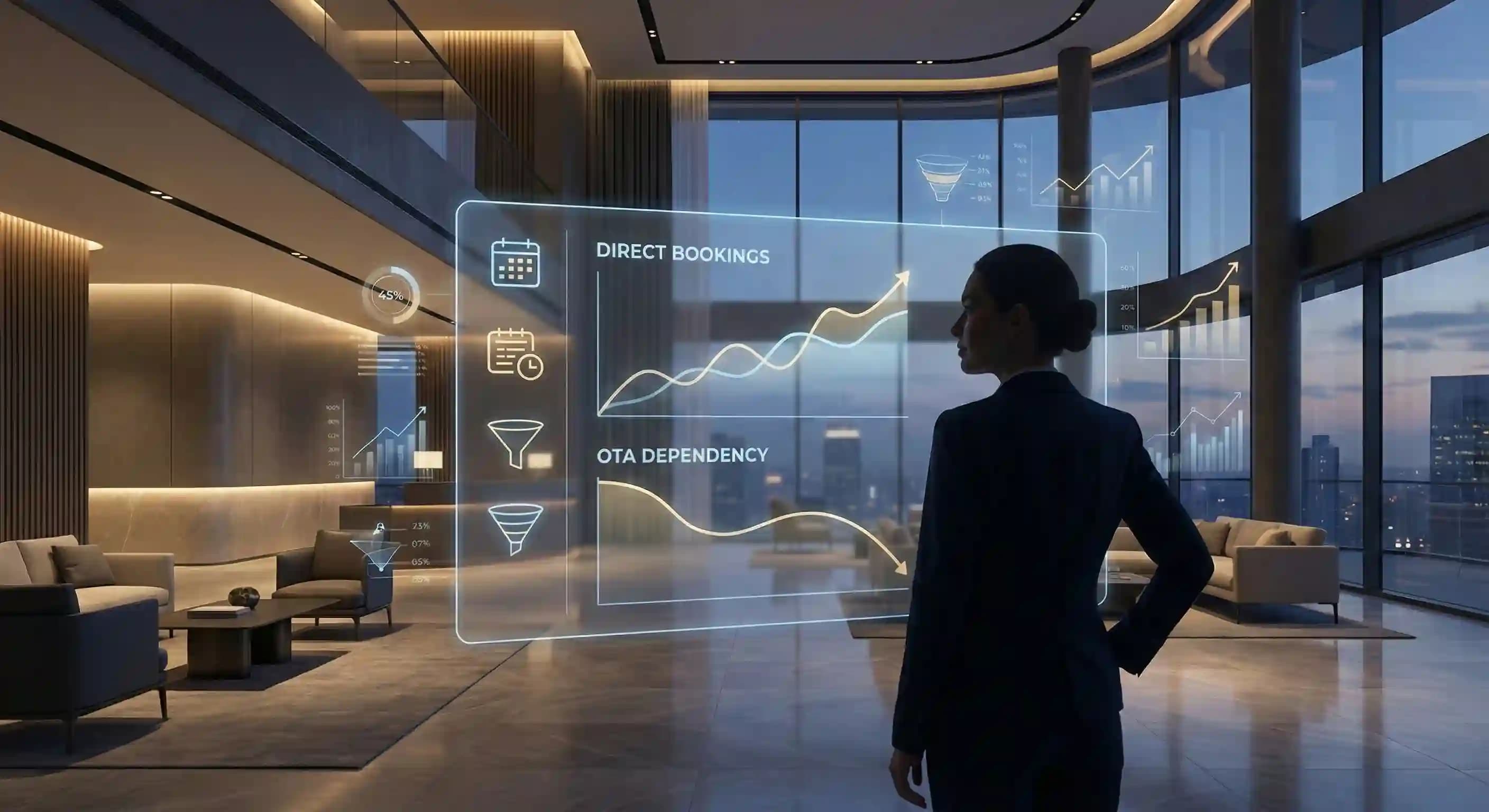
Why Do Direct Bookings End Up on OTAs at the Last Minute?
May 5, 2026
The user reached the payment screen, chose a room, saw the price — and at that exact second, closed the tab. Five minutes later they booked the same hotel through an OTA. What is the real reason behind this last-second escape?
In Short
A user picks a room, reaches the payment step, closes the tab at that exact second, and books the same hotel on Booking or Expedia minutes later. The reason is usually not price but trust and habit. OTAs offer a familiar comfort zone with one-click cancellation; if the hotel's payment screen cannot match that clarity, the user chooses the OTA even at a higher price. At the payment step a question also surfaces: is there a better route? Once instalment options or an OTA loyalty programme come to mind, the user opens the other tab and finishes there. The decision was in fact made when the room was chosen, but friction — a complex form, a tax detail added late — breaks that commitment at the moment of payment. Analytics that only count site entries never see this last-second escape. The answer is catching the hesitating user inside that narrow window.
Everything seems to be going perfectly on your hotel's website. The user has arrived on the homepage, selected dates, compared rooms, and has finally identified the room they want to stay in and moved to the payment step. And at that exact second... they close the tab. Five minutes later you see that the same user has made a reservation at your hotel — for the same room — through Booking.com or Expedia.
1. Even When the Price Is the Same, "Trust and Habit" Win
The biggest misconception hoteliers hold is that if they offer the same price (rate parity) as OTAs on their own site, the guest will naturally choose them directly. But when the user reaches the payment step, the decision is no longer purely about price. The user looks at the trustworthiness of your payment infrastructure, the transparency of your cancellation policy, and their own habits. OTA platforms offer users a comfort zone they have been accustomed to for years — one where they can cancel in seconds with a single click. If your site's payment screen cannot deliver that trust and clarity, the user will choose the OTA even if it is more expensive.
2. The Last-Second "Loyalty and Instalment" Check
When the user reaches the payment step, the question "Is there a more advantageous option?" stirs in their mind. Even though they selected the room on your site, the idea of interest-free instalment benefits on their credit card or an OTA loyalty programme they belong to crosses their mind. They open a side tab with a "let me just check." More often than not, a small advantage in their loyalty programme or a payment convenience causes them to complete the transaction on the OTA rather than on your site.
3. The Breaking of the Decision Moment and Process
Most hotels only look at the "result" moment — when the reservation was completed. But the user actually makes their decision much earlier (when they choose a room); they simply cannot carry that decision through to the final step because of various friction points. Sometimes a complex form on your payment page, sometimes a small tax detail added to the price at the last second, breaks the user's "mental commitment" in that moment. The purchase decision is most often made not on the payment screen, but immediately before they abandon.
4. Why Does the Loss Remain Invisible?
When a user has selected dates, chosen a room, seen the price, and reached the payment page — and then leaves at precisely that point — the problem is not the site's design or poor-quality traffic. The problem is entirely price clarity, a lack of trust, or indecision.
If your analytics tools only track how many people entered the site, you cannot see these specific "last-second escapes" at the payment step. Once this breaking point is identified, Reservation Optimization steps in for users who are wavering at the payment screen about to leave for an OTA. By intervening with the right callback or trigger in that narrow window while the sale is still warm, that hot sale is converted into direct, commission-free revenue.
For a deeper look at this topic, see our Hotel Website solution.
Related Posts
Why Do Users Disappear After Seeing the Price?
Every user who leaves the pricing screen does not mean a lost sale. The real problem is understanding which exits actually matter — and knowing who to chase and who to let go.
In Hotels, the Trust Problem Starts Before the Sale
In hospitality, the trust problem doesn't start with the SSL certificate on the payment screen. It breaks during the very first moments when the user is researching and trying to decide. The real disconnect happens the instant the phone rings.